
Have you ever pulled back the insulation in an older attic and found ceramic knobs threading cloth-covered wires through the joists? For many owners of homes built before the 1950s, that discovery raises an immediate and practical question: is knob and tube electrical safe enough to keep, or is it a liability waiting to surface? The answer depends less on the wiring's age and more on how it has been treated over the decades.
How Knob and Tube Systems Age Over Time
Knob and tube wiring was engineered for a different era, when a household drew power for a few lights and perhaps a radio. The copper conductors themselves are often surprisingly durable, but the insulation surrounding them is where age tells the real story. Rubberized and cloth coatings become brittle, crack, and flake away after seventy or eighty years of thermal cycling.
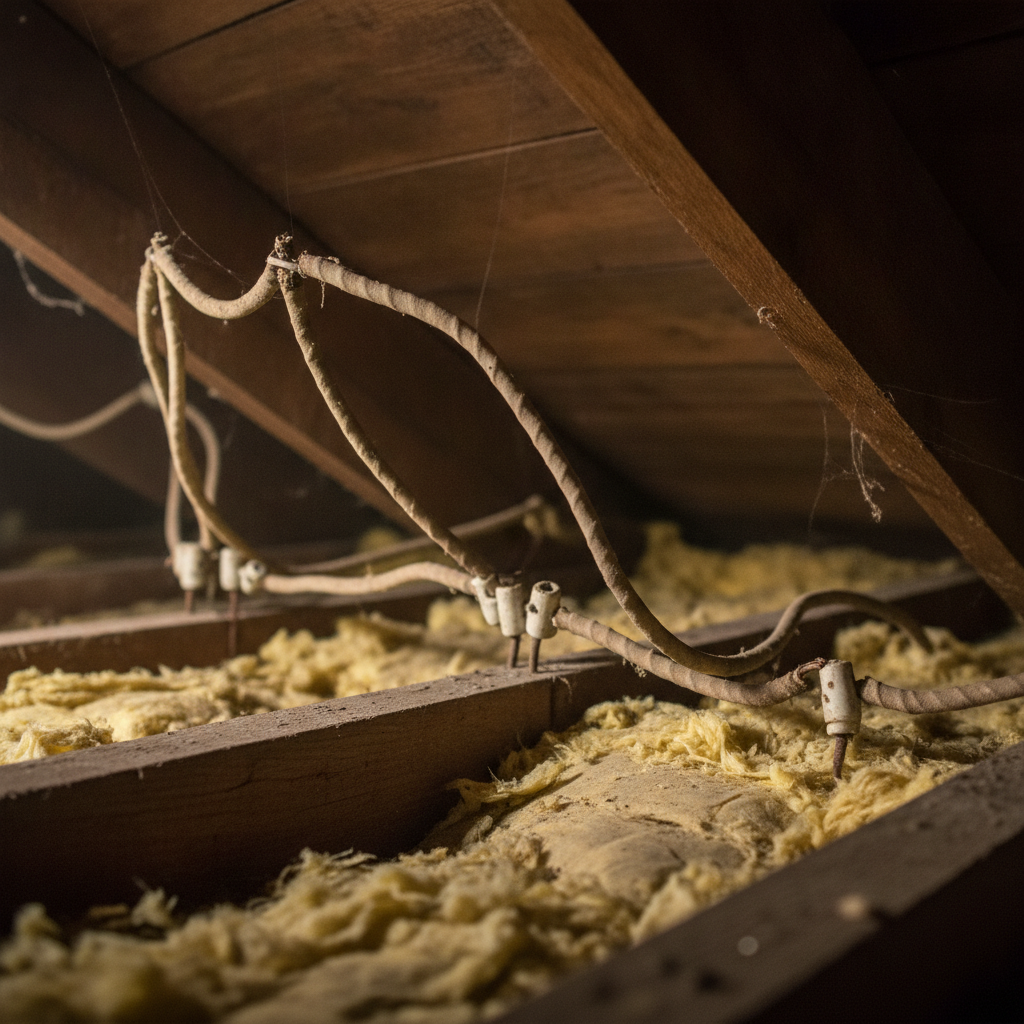
The system also relies on air circulation to dissipate heat, which was reasonable in an open wall cavity. Once a home is retrofitted with blown-in insulation, that cooling assumption disappears. What functioned safely in 1935 may behave very differently once conditions around it change.
Consider a typical case: a homeowner insulates the attic to lower heating bills, unknowingly burying live conductors that were never designed to sit against packed material. The wiring did not fail; its environment did.
Where Hidden Hazards Tend To Develop
Most serious problems in these systems do not stem from the original installation. They come from decades of modifications made by people who did not fully understand the wiring's limitations. A splice added in the 1970s to power a new outlet, taped rather than housed in a junction box, becomes a quiet point of failure. These accumulated alterations matter far more than the wiring's birth date.
Overloading is another recurring theme. A circuit sized for lamps now feeds window air conditioners, microwaves, and entertainment centers. The insulation degrades faster under sustained heat, and the absence of a grounding conductor removes a safety margin modern appliances expect.
Warning Signs Worth Inspecting Closely
Certain conditions signal that a system has moved from aging gracefully to posing genuine risk. Noticing them early can shape both your safety planning and your budget.
- Outlets that feel warm or show scorch marks around the faceplate
- Frequently tripping fuses or lights that flicker under load
- Cloth insulation that crumbles when touched during an inspection
- Amateur splices wrapped in tape rather than enclosed in boxes
- Insulation packed directly around conductors in attics or walls
Weighing Repair Against Full Replacement
The decision to patch or replace rarely comes down to a single factor. A small, well-maintained run of original wiring in an unfinished basement presents a different question than a fully insulated home with dozens of undocumented modifications. Your choice hinges on the extent of the system, its condition, and how long you intend to stay in the property.
Targeted repairs can address a single deteriorated section, and some homeowners take this route to extend a system's life while spreading out costs. The tradeoff is that partial fixes leave the rest of the network aging in place, and future work may repeat the same disruption.
Full replacement, by contrast, resolves the underlying issue in one pass. It also introduces grounded circuits, modern breakers, and capacity suited to current electrical demand. The upfront figure is larger, but it eliminates the recurring uncertainty of managing an obsolete system piece by piece.
Practical Factors That Shape The Cost
Rewiring estimates vary widely because the labor depends heavily on how accessible the wiring is. Understanding the drivers helps you interpret a contractor's quote rather than simply react to the bottom line.
- Square footage and the number of circuits needing replacement
- Whether walls are open or must be opened and later repaired
- Accessibility of attics, crawl spaces, and wall cavities
- Local permit and inspection requirements for electrical work
- Panel upgrades that may be needed to support new circuits
For a mid-sized home, whole-house rewiring commonly reaches into the five figures once drywall repair and finishing are included. That range explains why some owners phase the work across several years, prioritizing the highest-risk areas first.
Long-Term Value And The Path Forward
Beyond immediate safety, aging wiring affects two things owners often underestimate: insurability and resale. Many insurers now decline coverage or charge higher premiums on homes with active knob and tube systems, treating them as elevated risk. A buyer's inspector will flag the wiring, and financing can stall if a lender requires remediation before closing.
Modern wiring, on the other hand, quietly adds value. It removes an inspection red flag, supports the electrical load that today's households actually use, and gives a prospective buyer one less reason to negotiate the price downward. The investment tends to be recovered less through direct return and more through avoided friction.
Bringing in a licensed electrician for a documented assessment is the sensible starting point, since a professional can distinguish original conductors still in service from portions already replaced. That distinction alone often reshapes the scope and cost of any plan. Whether the answer is monitored maintenance or gradual replacement, the choice becomes clearer once the system's true condition is known. Owners weighing this decision have a range of service options and financing approaches available to match their timeline and budget.
Making An Informed Decision About Older Wiring
Knob and tube wiring is not automatically dangerous, nor is it something to dismiss as a minor quirk of an older home. Its risk profile is defined by decades of use, modification, and changing conditions rather than by its original design. A system left untouched in a dry, uninsulated space may pose little concern, while the same wiring buried under insulation and burdened with modern loads deserves serious attention.
The practical path is to understand what you actually have, weigh the cost of repair against replacement, and factor in insurance, resale, and how long you plan to own the home. With that information in hand, you are positioned to make a decision that reflects both your safety priorities and your financial circumstances.