
When your washer stops mid-cycle or starts leaking across the laundry room floor, how do you decide whether to call a technician or shop for a replacement? The answer usually comes down to a few numbers and the age of the machine. Understanding what common fixes actually cost, and how that compares to a new unit, puts you in a stronger position to make a sound financial call.
Why the Repair-or-Replace Question Matters
A washing machine failure rarely arrives at a convenient time, and the pressure to restore your laundry routine can push you toward a hasty decision. Spending $350 on a repair for a machine already nearing the end of its life can feel like money poured into a sinking boat.
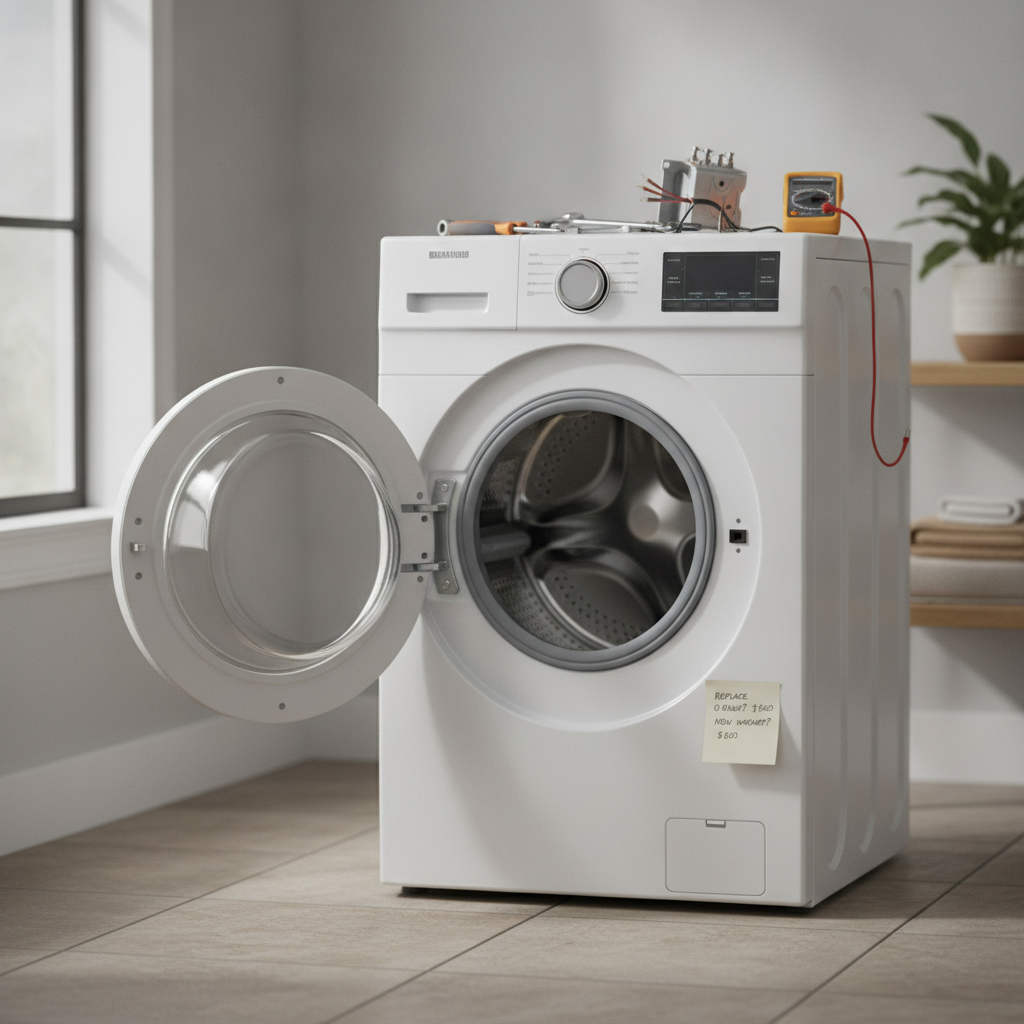
On the other hand, replacing a three-year-old washer over a $150 fix wastes money and sidelines an appliance with years of service left. The goal is to match the cost of the solution to the realistic value of the machine you own.
Typical Washing Machine Repair Cost by Problem
Repair pricing varies by brand, region, and whether you own a top-load or front-load model, but the symptom usually signals the part at fault. A washer that fills but won't drain points to the pump. One that spins poorly often has a worn belt or motor coupling. Knowing the likely culprit helps you anticipate the washing machine repair cost before a technician arrives.
Labor typically runs between $75 and $150 an hour, and most service calls carry a diagnostic fee that may be waived if you proceed with the work. Parts markup can add meaningfully to the total.
Common Failures and Their Price Ranges
- Drain pump replacement, often $150 to $300 including labor
- Drive belt replacement, frequently $120 to $250
- Door or lid lock and switch, around $150 to $350
- Water inlet valve, roughly $150 to $300
- Motor or motor coupling, commonly $200 to $450
- Control board or timer, often $250 to $500 or more
What a New Washer Actually Costs
Before you can weigh a repair fairly, you need a clear picture of replacement pricing across the range you'd realistically buy. A basic top-load unit starts around $500, while mid-range front-load machines land between $700 and $1,200. High-efficiency and smart models can exceed $1,500.
Remember to factor the full cost of switching, not just the sticker price. Delivery, installation, and haul-away of the old unit can add $50 to $200, and a new water line or power configuration occasionally adds more.
The Age and Lifespan Factor
Age is the single most useful variable in this decision. Most washers are built to last roughly 10 to 13 years, and the probability of a second failure climbs steeply once a machine passes the eight-year mark. A costly repair on an older unit frequently buys only a short reprieve before another component gives out.
A practical benchmark many technicians use is the 50 percent rule. If a repair costs more than half the price of a comparable new machine, replacement usually makes better long-term sense.
When Repair Tends to Win
- The machine is under eight years old
- The repair falls well under half the cost of a replacement
- The failed part is a wear item like a belt, pump, or valve
- The unit is otherwise reliable with no history of repeated issues
When Replacement Tends to Win
- The washer is ten years old or more
- The quote involves the motor, transmission, or main control board
- You've already paid for one or two repairs recently
- Rust, drum damage, or persistent leaks point to broader wear
Energy Efficiency and Long-Term Value
The repair-versus-replace math isn't only about today's invoice. A washer from a decade ago uses noticeably more water and electricity than a current high-efficiency model, and those operating costs accumulate quietly over years of weekly loads.
If you run several loads a week, a modern machine can trim utility costs enough to offset part of its purchase price over its lifespan. Factoring this ongoing savings into your appliance budget sometimes tips an otherwise marginal decision toward replacement, especially when the old unit is already overdue for service.
Service Options and Doing It Yourself
How you source the fix influences the total as much as what breaks. A manufacturer's authorized service may cost more than an independent technician but offers genuine parts and specialized knowledge of your model. Independent shops often price more competitively and work across brands.
Some repairs are well within reach of a confident homeowner. Swapping a drain pump or inlet valve requires basic tools, patience, and a reliable repair video, and buying only the part can cut a $250 job to under $60.
Repairs Many Owners Can Handle Themselves
- Clearing a clogged drain pump filter or hose
- Replacing a worn drive belt on a top-load machine
- Installing a new water inlet valve
- Swapping a faulty door or lid switch
Weighing Warranties and Repair History
Before you authorize any work, check whether the machine still carries coverage. Many washers include a one-year general warranty, and some manufacturers back the motor or drum for ten years, which can turn a $400 repair into a free one. An extended protection plan, if you purchased one, may cover parts and labor outright.
Repair history matters too. A machine that has needed two service calls in eighteen months is signaling a pattern, and continuing to invest in it rarely pays off.
Making the Decision That Fits Your Budget
Putting these pieces together turns an urgent problem into a straightforward calculation. Start with the repair quote, compare it against half the price of a suitable replacement, and layer in the machine's age, its repair history, and the efficiency gains a newer model would deliver. A clear repair-vs-replace framework keeps you from overpaying in either direction.
Each household weighs these factors differently depending on finances, usage, and tolerance for risk, and the right choice is the one that aligns with your own appliance budget and expectations.
Whatever you decide, gather a written estimate, confirm what the diagnostic fee covers, and keep records of any work performed. Those small habits protect your spending today and inform the next decision down the road.