
Have you opened your refrigerator to grab a cold drink only to find the inside feels closer to room temperature than you'd like? A fridge that stops cooling is one of the more stressful appliance problems because the clock is running on everything inside. The good news is that a warm refrigerator rarely means the whole unit has failed. More often, a single component has stopped doing its job, and several of those components are approachable for a careful owner.
Reading the Early Warning Signs
Before you pull the fridge away from the wall, it helps to interpret what the appliance is telling you. A unit that cools unevenly, runs constantly, or hums louder than usual is giving you clues about where the trouble lives. Noticing whether the freezer still works while the fresh-food compartment warms, for example, points you toward the defrost or airflow system rather than the compressor.
Pay attention to timing as well. A gradual decline over a week suggests dust buildup or a struggling fan, while a sudden loss of cooling overnight often points to a failed part or a tripped control. These distinctions save you from replacing the wrong component and spending money you didn't need to.
Why Dirty Condenser Coils Are the Usual Suspect
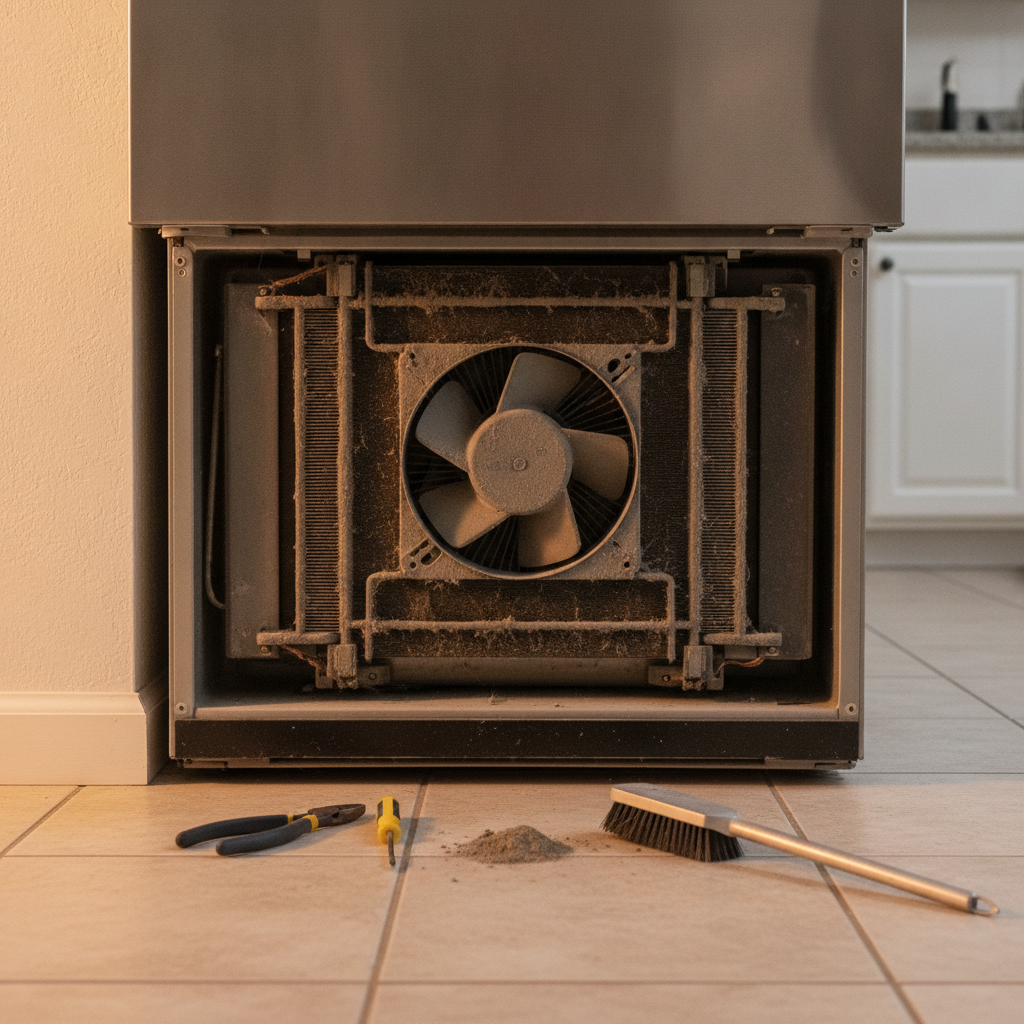
If you only check one thing when your refrigerator is not cooling, make it the condenser coils. These coils release the heat pulled out of the fridge, and when they're caked in dust, pet hair, and kitchen grease, they can't shed that heat efficiently. The compressor then runs longer and hotter, cooling drops, and your energy bill quietly climbs.
Coils live either behind a front kick plate at the bottom or across the back of the unit. Cleaning them is one of the highest-value maintenance tasks you can perform, often restoring normal cooling for the cost of nothing more than your time.
Tools That Make Coil Cleaning Easier
- A long, slim coil brush that reaches between tightly spaced fins
- A vacuum with a crevice attachment to capture loosened debris
- A flashlight to inspect areas you can't easily see
- A screwdriver if your model hides the coils behind a panel
Checking the Condenser and Evaporator Fans
Clean coils still need moving air to work, and that's the job of the condenser fan near the compressor and the evaporator fan inside the freezer. When a fan motor seizes or slows, heat lingers around the coils or cold air never circulates into the fresh-food section. A fridge that feels warm up top but frozen below frequently has an evaporator fan problem.
You can often hear a struggling fan as a buzzing, clicking, or grinding noise. With the unit unplugged, spin the blades by hand to feel for stiffness or obstruction, and look for ice buildup that may be blocking the blade entirely.
Symptoms That Point to a Failing Fan
- Unusual rattling or grinding that changes when a door is opened
- A freezer that stays cold while the refrigerator section warms
- A fan blade that won't spin freely by hand
- Frost accumulating in one area rather than evenly
Understanding the Defrost System
Modern refrigerators periodically melt frost off the evaporator coils so air can keep flowing. When any part of that defrost system fails, frost grows into a solid block of ice, airflow stops, and cooling falls off even though the compressor runs fine. This is one of the most misdiagnosed issues in appliance repair because the symptoms mimic a dead compressor.
The system relies on a timer or control board, a heater, and a thermostat working in sequence. A quick clue is pulling off the freezer's inner back panel; a wall of ice there tells you the defrost cycle has stopped happening.
Components Worth Testing in the Defrost Circuit
- The defrost heater, which should show continuity on a multimeter
- The defrost thermostat, which opens and closes based on temperature
- The defrost timer or control board that triggers the cycle
- The bimetal sensor that protects against overheating
Deciding What You Can Safely Handle Yourself
Not every repair carries the same risk or difficulty. Cleaning coils, clearing a blocked vent, or swapping a plug-in fan motor are reasonable weekend tasks for most people. Testing electrical components with a multimeter is approachable if you're comfortable unplugging the unit and following your model's wiring diagram. Sealed-system work involving refrigerant, by contrast, requires certification and specialized equipment.
Being honest about your comfort level protects both you and the appliance. A fan motor installed backward or a connector left loose can create a new problem on top of the original one, so weigh the time saved against the chance of a costly mistake.
Weighing Repair Costs Against Replacement
At some point the practical question becomes whether a repair is worth it. A ten-year-old unit that needs a compressor is a different calculation than a three-year-old model with a failed fan. As a rough guide, many owners draw the line when a repair approaches half the price of a comparable new refrigerator, especially once the age of the unit is factored in.
Energy efficiency matters here too. A newer model can trim ongoing operating costs enough to offset part of its purchase price over several years, which can tip the decision when a major component is involved.
Factors to Weigh Before Spending on a Fix
- The age of the refrigerator relative to its expected lifespan
- The quoted part and labor cost from a service call
- Whether multiple components are failing at once
- Potential energy savings from a more efficient replacement
When to Bring in a Professional
Some situations genuinely call for a trained technician. If you've cleaned the coils, confirmed the fans spin, and ruled out the defrost system but the fridge still won't cool, the trouble may lie in the compressor, the start relay, or a refrigerant leak. These sit beyond the reach of basic home tools and sometimes beyond what's legal for an uncertified person to touch.
A service visit also buys you a diagnosis you can trust before committing money. Many technicians apply the diagnostic fee toward the repair, which softens the cost of simply knowing what's wrong.
Keeping Your Refrigerator Cooling for the Long Run
The most reliable way to avoid a surprise warm fridge is steady, modest upkeep. Vacuuming the condenser coils twice a year, keeping the unit a few inches from the wall for airflow, and not overpacking the shelves all reduce strain on the parts most likely to fail. These habits cost almost nothing and extend the service life of an appliance you depend on daily.
Treat the warning signs as information rather than emergencies. A fridge that tells you something is slipping gives you the chance to act while the fix is still small, and that early attention is what separates a quick cleaning from a replacement decision.